Smart A-Frame Home: Automation and IoT for Your Cabin
How to fit an A-Frame with smart systems: remote heating, security, humidity sensors, and energy monitoring for a home that isn't used every day.
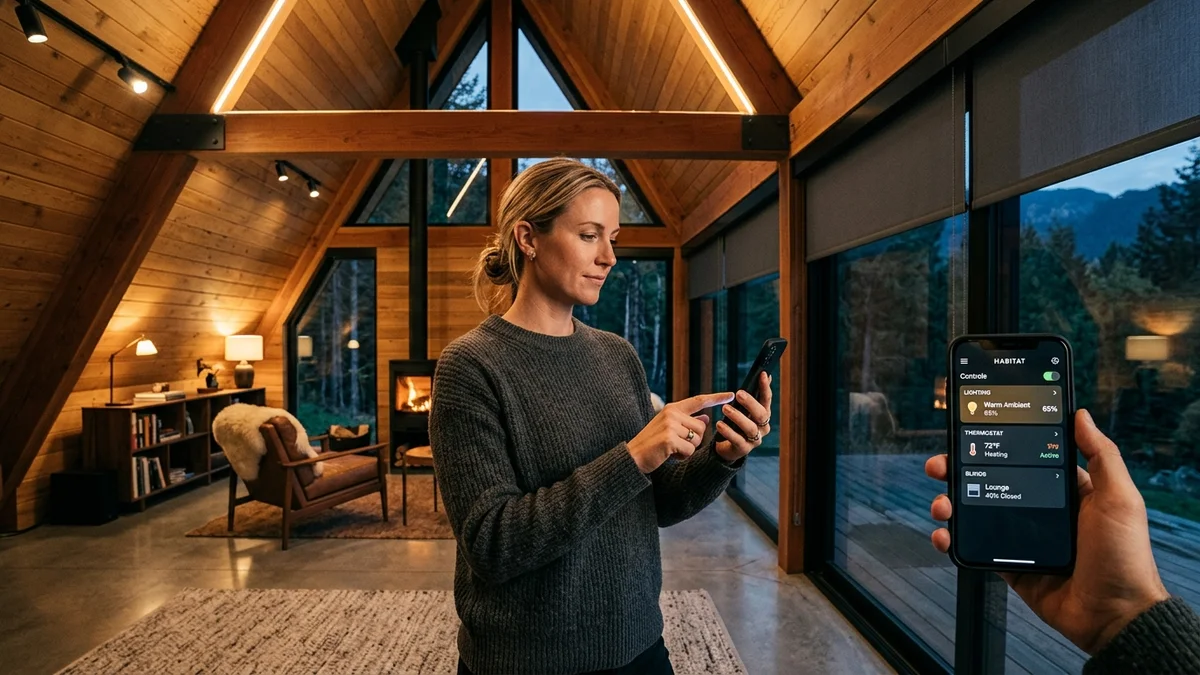
An A-Frame house is rarely a permanent residence. More often it is a weekend retreat or holiday cabin that sits empty for days or weeks between visits. That is exactly why smart technology delivers more value here than in a home someone occupies daily. Remote monitoring, protecting an empty building, and arriving to an already warm interior turn IoT systems from a luxury into a practical investment. This guide walks through everything you need to equip your triangular house with smart solutions, from remote heating to energy monitoring.
Why Smart Tech Makes Sense for an Intermittently Used Cabin
When a house stands empty, many problems develop quietly and unseen. A pipe bursts during a frost, humidity builds up under the steep roof, a power cut thaws the freezer — and you only notice at your next visit, when the damage is already done. Smart sensors and monitoring systems solve exactly this problem: they push a notification to your phone the moment something goes wrong, whether you are ten or five hundred kilometres away.
The second big advantage is a comfortable arrival. Instead of walking into a cold house and waiting hours for it to warm up, a smart thermostat starts the heating while you are still on the road. You arrive to a space that is already warm and ready to enjoy.
Remote Heating and Climate
The heart of a smart cabin is remotely controlled heating. A smart thermostat lets you switch on the heating from an app a few hours before arrival, so you walk into a house warmed to a comfortable 21°C.
While you are away, the system holds a frost-protection mode — a low setpoint, typically around 5-8°C, high enough to protect the plumbing and installations while consuming a minimum of energy. This matters especially for A-Frame houses in mountain regions where winter temperatures drop well below zero.
A smart thermostat integrates easily with different heat sources:
| Heat source | Advantage for a cabin | Note |
|---|---|---|
| Heat pump | Efficient, quiet, remotely controllable | Ideal for the baseline mode |
| Electric panels | Fast warm-up, cheap to install | Higher running cost |
| Wood stove | Independent of the grid, great atmosphere | Requires manual lighting |
The recommended approach is a combination: a heat pump or panels for automatic temperature maintenance, with a wood stove as a backup in case of a power cut. Read more about choosing a system in our article on A-Frame heating systems.
Monitoring the Empty Cabin
An A-Frame house has a specific humidity problem. Warm, moist air rises toward the tall roof apex, so condensation and potential mould appear first up high, near the ridge. That is why humidity sensors should be placed high, in the apex zone, and not only at floor level where they would miss the real problem.
The key sensors for an empty cabin are:
- Humidity and temperature sensors — placed high under the roof and at ground level, warning of conditions that favour mould.
- Water-leak sensors — placed under the sink, water heater, and near plumbing connections, catching a leak before it turns into major damage.
- Freeze sensors — sending an alert to your phone the moment the temperature drops below a safe threshold.
All of these sensors can push a notification straight to your phone so you can react in time. Proper insulation further reduces the humidity risk — see our guide on insulation and energy efficiency.
Security in Remote Locations
Cabins are often in isolated spots, which makes them a target for burglars. A smart security system plays a dual role here: it deters and it informs.
Cameras with motion detection send a clip to your phone the moment they register movement. Smart locks let you grant guests or renters temporary access without physically handing over a key — extremely useful if you rent the cabin out. Motion and door sensors round out the system.
A crucial note for remote locations: always plan an LTE/4G cellular backup. Remote sites frequently lose power and internet, and that is exactly when monitoring matters most. A mobile router with a backup battery keeps the systems connected even when fixed-line internet fails. If you plan to rent, details on access and management are in our guide to the A-Frame rental business.
Connectivity in Remote Areas
Reliable internet is the foundation of any smart system, and it is not always available in mountains and forests. There are a few solutions:
- 4G/LTE router — the simplest option where there is a mobile signal.
- Satellite internet (Starlink) — reliable and fast even at very isolated sites, with a monthly cost and an initial hardware investment.
- Mesh Wi-Fi network — covers the tall, open volume of an A-Frame house without dead spots.
An interesting advantage of A-Frame construction is the open interior with a high apex, which helps the Wi-Fi signal spread evenly throughout the house, including the loft and mezzanine.
Energy Management
Smart systems work best paired with solar panels and battery storage. This combination is ideal for a cabin that may be fully or partly off-grid.
A consumption-monitoring system shows you in real time how much energy individual devices use, while an automatic load-shedding function switches off less essential loads when the battery is low, preserving energy for heating and monitoring. You can also add electric-vehicle charging when there is surplus solar energy.
Read more about the solar installation in our article on solar panels on an A-Frame roof, and about living without a grid connection in our guide to off-grid living.
Budget Tiers for a Smart Cabin
| Tier | Budget | What it includes |
|---|---|---|
| Entry (DIY) | ~€300-600 | Smart thermostat, a few humidity and leak sensors, one camera |
| Mid | ~€1,000-2,000 | Multiple cameras, smart locks, LTE backup, integrated sensors |
| Fully integrated | €3,000+ | Central hub, solar integration, energy monitoring, automation |
You can install the entry tier yourself over a single weekend, and it already covers the most important risks. The higher tiers bring full automation and integration with renewable sources.
Frequently Asked Questions
Do smart devices work when the cabin loses power or internet?
Partly. Devices with a battery backup and an LTE/4G connection keep working and sending alerts even when fixed-line internet fails. That is why, for remote sites, a cellular backup and a small UPS battery for the router and sensors are practically essential. Without them, a power cut leaves you blind precisely when you most need visibility.
Can I turn on the heating before I arrive?
Yes, and it is one of the most useful features. Using the phone app you start the heating a few hours before arrival and walk into an already warm house. Some systems also use geolocation and start the heating automatically as you approach the property.
Is it worth it for a cabin used only in summer?
It is worth it even then, just at a reduced scope. Even a summer cabin benefits from water-leak sensors, cameras, and remote monitoring while it stands empty through winter. You may not need remote heating, but protecting the empty building and the peace of mind that remote visibility brings are valuable for seasonal use too.
Plan Your Smart A-Frame Home
Smart systems start with a well-designed house — knowing the areas, room volume, and energy needs helps you size the heating, solar capacity, and sensor layout precisely. Use our A-Frame calculator to work out your home's dimensions and energy parameters, then plan the automation with solid numbers in hand. For the bigger picture of sustainable building, also see our guide to the sustainable A-Frame.
An A-Frame Acoustics Guide
A good A-frame guide starts with observation, not a universal prescription. Consider a lively dinner turning into an exhausting conversation under an open roof volume. The cabin’s location…
The Dog-Friendly A-Frame Retreat
A useful A-frame solution begins with a real weekend scenario, not a theme. Imagine a dog coming inside with wet paws while people are unloading for the weekend. The cabin has to make that…
The Gear Wall That Saves Your Weekend
A weekend cabin is at its best when an ordinary moment becomes easier to enjoy. For this topic, that moment is a wet jacket, boots and a daypack arriving at the same time as groceries. It…